What EDM means
EDM, electronic dance music, is a catch-all name, not a genre with fixed rules. DJs and producers talk in families instead: house, techno, trance, bass music, hard dance. Inside each family the styles blend into each other, and the names drift over the years.
When you're trying to place a track, listen for three things:
- Tempo. It narrows the field fast: 124 BPM and 174 BPM are different worlds.
- Drum pattern. A kick on every beat (four-on-the-floor), a broken beat, or a half-time feel with the snare on beat 3.
- Bass and melody. Is the track carried by groove, by a big melody, or by a heavy bass sound?
The tempos below are typical ranges, not rules. Plenty of tracks sit outside them.
The house family
House
About 118–128 BPM. A kick on every beat, an open hi-hat on the offbeat, and a groove that comes from disco and soul: pianos, vocals, funky basslines. Almost every style in this article borrows something from house.
Deep house
About 115–125 BPM. Warmer and softer than house: jazzy chords, a round bass, more space, and few big drops. It works as a warm-up or for long, smooth sets.
Tech house
About 122–128 BPM, often 124–126. House groove stripped down and mixed with techno's rolling percussion. The bassline does most of the work, and vocals are usually short hooks. It's built for the middle of a club night.
Progressive house
About 122–130 BPM. Long builds, layered melodies, and slow change over six to eight minutes. The festival version is more anthemic, the underground version more hypnotic.
Big room
About 126–132 BPM, very often 128. The festival sound: a huge kick, simple and loud leads, long snare-roll build-ups, and drops designed for a field of people jumping at once.
Techno and trance
Techno
About 125–140 BPM, with harder styles going past 140. Repetitive, hypnotic, and machine-like. There's little melody; tension comes from percussion, texture, and synths that slowly change shape. It's more about the journey than the hook.
Melodic techno
About 120–126 BPM. Techno's drive with emotional, cinematic arpeggios and pads, plus long breakdowns. The line between melodic techno and melodic house is blurry, and many stores mix them up.
Trance
About 132–140 BPM. Big melodies, wide supersaw chords, and long breakdowns that build into a euphoric release. Psytrance, a faster offshoot around 140–148 BPM, swaps the big chords for a rolling bassline and twisting synth effects.
Bass music and hard dance
Dubstep
About 140 BPM, but it feels like 70 because the snare lands on beat 3, a half-time feel. Wobbling, growling bass sounds take the place of a melody, and the drop is the main event.
Drum and bass
About 165–178 BPM, most often 172–175. Fast breakbeats over a deep sub bass. It ranges from smooth, melodic liquid styles to dark, aggressive ones, and DJs often mix it in long, fast blends.
Future bass
Roughly 130–160 BPM, usually felt at half-time. Lush, detuned chords that swell and pump, pitched vocal chops, and a bright, emotional mood. The drop is a wall of chords rather than a bass growl.
Hardstyle
About 150–160 BPM. A distorted kick that carries much of the energy, euphoric leads, and big breakdowns. Loud, punchy, and unmistakable within a few seconds.
EDM subgenres at a glance
| Subgenre | Usual BPM | Drum feel | What stands out |
|---|---|---|---|
| House | 118–128 | Four-on-the-floor | Groove, pianos, vocals |
| Deep house | 115–125 | Soft four-on-the-floor | Warm chords, round bass |
| Tech house | 122–128 | Four-on-the-floor | Rolling percussion, bass hooks |
| Progressive house | 122–130 | Four-on-the-floor | Long builds, layered melodies |
| Big room | 126–132 | Four-on-the-floor | Huge drops, simple leads |
| Techno | 125–140 | Four-on-the-floor | Hypnotic, little melody |
| Melodic techno | 120–126 | Four-on-the-floor | Emotional arpeggios, long breaks |
| Trance | 132–140 | Four-on-the-floor | Big melodies, euphoric breakdowns |
| Psytrance | 140–148 | Four-on-the-floor | Rolling bass, trippy effects |
| Dubstep | About 140 | Half-time | Wobble and growl bass |
| Future bass | 130–160 | Half-time | Swelling chords, vocal chops |
| Drum and bass | 165–178 | Breakbeat | Fast drums, deep sub bass |
| Hardstyle | 150–160 | Four-on-the-floor | Distorted kick, euphoric leads |
| Vinahouse | 130–145 | Four-on-the-floor | Bouncing bass, remixed familiar songs |
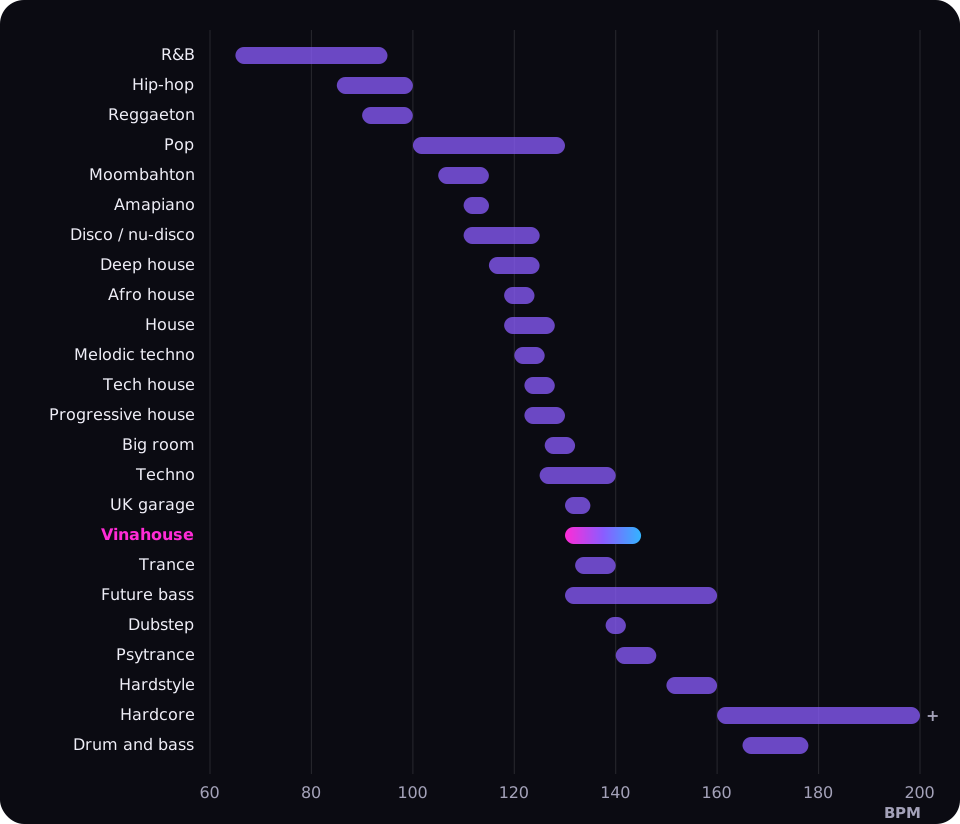
Notice how much the ranges overlap. A 126 BPM track could be tech house, progressive house, or techno. Tempo narrows things down; the sound decides. For the full tempo chart, including genres outside EDM, see the BPM of music genres.
Why downloaded genre tags are so often wrong
If you've ever sorted by the Genre tag, you know the result is a mess. A few reasons:
- Stores tag the release, not the track. A whole EP gets one genre, even when the B-side is a different style.
- Names drift. What one store calls progressive house, another calls melodic house. Styles get renamed as trends change.
- Remixes keep the original's tag. A club remix of a pop song often still says "Pop", and files from sharing groups say "Dance", "Electronic", or nothing.
- Genre says what a track is, not when you play it. Two techno tracks can be an opener and a peak-time weapon.
That's why many DJs ignore the tag and build their own crates. More on that in why genre tags fall short.
How DJs split music their own way
Instead of copying a store's genre list, split by what you need when picking the next track:
- By role in the set: warm-up, build, peak, closing.
- By energy or mood: chill, groovy, driving, dark, euphoric. See organizing music by mood and energy.
- By genre, refined to how you play: "Tech house groovy" and "Tech house peak" instead of one big tech house folder.
Whatever you choose, keep 4–8 crates to start, make sure they sound clearly different, and give each track one main crate.
FAQ
What's the difference between house and techno?
House is warmer and more song-like: groove, chords, vocals, a bit of funk, usually around 118–128 BPM. Techno is more repetitive and hypnotic, with little melody, and often a little faster, around 125–140 BPM. If you find yourself humming it, it's probably house.
What is the fastest EDM genre?
Among the common styles, drum and bass is the fastest, at about 170–175 BPM, followed by hardstyle at about 150–160. Hardcore and its offshoots go even faster, often 160–200 BPM or more.
Is dubstep 70 or 140 BPM?
Usually about 140 BPM, but the snare on beat 3 makes it feel like 70. Software can show either number. See half-time and double-time BPM for why that happens and how to read it.
Is Vinahouse a type of EDM?
In the broad sense, yes. It's Vietnamese club music around 130–145 BPM, built on familiar songs with a heavy, bouncing bass. Read what Vinahouse is for the full picture.
Faster with Taxonomy DJ
Genre tags won't organize your crates, so automatic music classification in Taxonomy DJ learns from labels you name yourself, like "Tech house groovy", "Melodic warm-up", or "Peak techno":
- In the Training tab, click Add label for each example folder, or From parent folder to add a whole set of folders at once.
- In the Music Library tab, click Add music folder, choose Run full analysis, then click Scan. Every track gets a label in the Prediction column with a % Confidence.
- Click Quick filter ▸ Needs review, listen to the unsure tracks, and fix labels with the 1–9 keys.
- Select tracks, then File ▸ Copy to folder to get one subfolder per label.
Training and automatic labeling need Premium. BPM, key, and Camelot for your whole library are free.
Read next: what Vinahouse is and the BPM of music genres.