
What Vinahouse is
Vinahouse, also written Vina house, is the umbrella name for Vietnamese-style club music. Before the name stuck, people in Vietnam simply called it club music or nightclub music. The "house" part tells you where it comes from: a kick on every beat, like house music. But Vinahouse is faster, the bass is thicker, and the whole thing hits much harder.
What really sets Vinahouse apart is the source song. Most Vinahouse tracks are remixes of something people already know by heart: Vietnamese pop, ballads, sometimes a famous foreign hit. The crowd sings the vocal, then dances to the bass. Put those two together and you have the formula for a Vinahouse track that works.
Where Vinahouse comes from
Vinahouse grew up in clubs and bars across Vietnam, starting around the late 1990s and gaining momentum through the 2000s. Local DJs noticed that the crowd reacted hardest to songs it already knew, so they remixed domestic hits in a club style to play them on the dance floor. Over time that way of remixing became a style of its own.
Vietnamese communities abroad carried the sound with them. In recent years, short clips on social media brought Vinahouse to listeners everywhere, and the name "Vinahouse" became known well beyond Vietnam.
One thing worth knowing: most of Vinahouse history lives in nonstop mixes passed from hand to hand and remix files shared in groups, not in music stores. That's why the genre tag on a Vinahouse file is almost always empty, or a vague "Dance" or "Electronic".
What Vinahouse sounds like
| Element | What you usually hear |
|---|---|
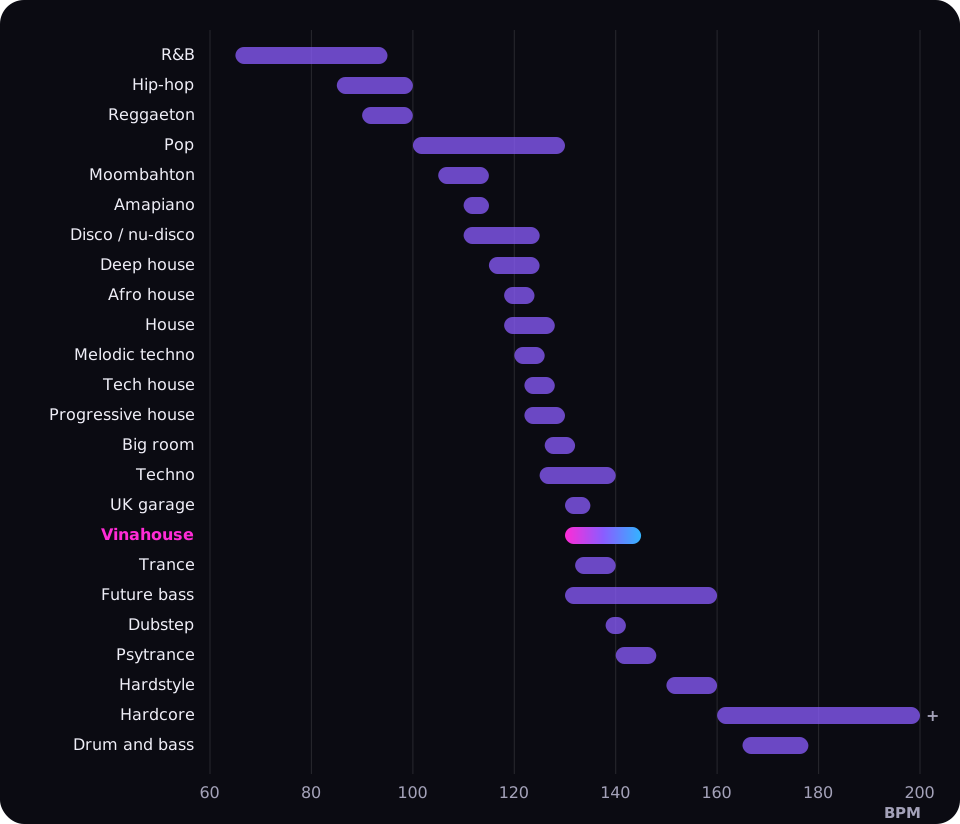
| Tempo | About 130–145 BPM, faster than typical house (about 120–128) |
| Kick | Four-on-the-floor, solid and heavy, cutting through club speakers |
| Bass | A bouncing bass that lands between the kicks, thick and relentless |
| Lead | A high, sharp synth playing the original melody or a new hook |
| Vocal | The original song's vocal, often chopped, looped, or pitched up |
| Effects | Shouts, risers, and snare rolls before the drop |
The bass is what makes people move. The kick holds the beat, and the bass fills the gap between two kicks, so the groove bounces nonstop. Take the bass away and a Vinahouse track sounds close to a fast house track.
A typical Vinahouse track structure
- Intro: kick and percussion, often 16–32 bars, enough for a DJ to mix in from the previous track.
- Vocal section: the original melody, with the bass light or not in yet.
- Build-up: snare rolls, risers, sometimes the kick drops out completely.
- Drop: the bouncing bass and the lead come in full force. This is what the crowd waits for.
- Break, then a second drop, usually bigger than the first.
- Outro: back down to kick and percussion so the DJ can move to the next track.
Not every track follows this exactly, but most tracks made for the club do.
Vinahouse styles: xung, bright, dark, deep, floating
Vinahouse has no official set of subgenres. The names below are what players call them. Many DJs split their music this way, but every crew and every city reads them a little differently. The Vietnamese names are the ones you'll see on folders.
| Name | What you usually hear | Often played |
|---|---|---|
| Houselak (house lắc) | An older style, steady bouncing bass, fewer hard drops | Throwback sets, regulars who like the old sound |
| Xung | Thick pumping bass, heavy kick, high energy | Middle of the set, when the room is full |
| Xung Sáng (bright) | Bright leads, happy melodies, many in major keys | Lifting the mood, crowd sing-alongs |
| Xung Tối (dark) | Dark tone, growling bass, little melody | When you want a heavier, tenser set |
| Deep | Much slower, lighter, more space, usually under 125 BPM | Openers, chill bars, late night |
| Trôi (floating) | Long leads, few breaks, a weightless feel | Stretching one seamless section of a set |
| Căng (intense) | The most relentless, hardest drops | Peak time |
"Việt Mix" or "nonstop" isn't a style but a format: a long mix that runs many tracks together, usually from one style.
The key point: these styles differ in energy, brightness, and how the bass hits, not in BPM. Two tracks at 136 BPM in the same key can still be one Xung Sáng and one Xung Tối. So filtering by the BPM of each genre narrows things down but can't sort Vinahouse for you.
How to organize a Vinahouse library your way
With no shared standard, the best Vinahouse library is the one split exactly the way you play:
- Name folders the way you think behind the decks. If you think "time for Xung Tối", then Xung Tối is a folder.
- Pick one main axis. Either mood (bright, dark, floating) or role in the set (opener, middle, peak, cool-down). Mixing both axes in one set of folders gets confusing fast.
- Start with 4–8 folders. Too few and each one is too broad; too many and tracks end up stuck between two.
- One main folder per track. If a track sits between two styles, park it in a separate folder and listen again later.
- Clean out duplicates. One song often has several remixes and several identical files downloaded from different groups. See how to find duplicate music files.
- Have BPM and key for every track. Vinahouse transitions are often quick, but two vocals overlapping in clashing keys sound harsh right away.
The most expensive part of sorting by hand is listening to every new track to decide which style it belongs to. To let software do that part, read how to classify Vinahouse and EDM your own way.
FAQ
What BPM is Vinahouse?
Usually around 130–145 BPM. Deep Vinahouse is much slower, often under 125 BPM. If software shows a Vinahouse track at about 65–72 BPM, it's almost certainly reading half the real tempo; see half-time and double-time BPM.
How is Vinahouse different from house music?
House usually sits around 120–128 BPM, with a looser groove and a rounder, less relentless bass. Vinahouse is faster, its thick bass bounces between the beats, and it's usually built on a song the crowd already knows by heart.
Is Vinahouse a type of EDM?
In the broad sense, yes: it's electronic music made for dancing. But international music stores have almost no Vinahouse category, so files usually carry a "Dance" or "Electronic" tag. See EDM subgenres explained.
What's the difference between Houselak and Vinahouse?
Many people see Houselak as the older style: a steady bouncing bass, lighter, with fewer hard drops. Later Vinahouse is faster with a heavier, pumping bass. The line between them is blurry and every DJ draws it differently, so trust your own ears.
Faster with Taxonomy DJ
There's no standard Vinahouse tag, so automatic music classification in Taxonomy DJ learns straight from the folders you've already organized:
- In the Training tab, click Add label for each example folder, like Xung Sáng, Xung Tối, Deep, or Houselak. All of them inside one parent folder? Click From parent folder.
- In the Music Library tab, click Add music folder, choose Run full analysis, then click Scan. Every track gets a label in the Prediction column with a % Confidence.
- Click Quick filter ▸ Needs review to listen only to the tracks it isn't sure about, and fix labels with the 1–9 keys.
- Select tracks, then File ▸ Copy to folder: one subfolder per label, originals untouched.
Training and automatic labeling need Premium. BPM, key, and Camelot for every track (Analyze waveforms) and copying or moving files work on the Free plan too.
Read next: how to classify Vinahouse and EDM your own way and the BPM of music genres.