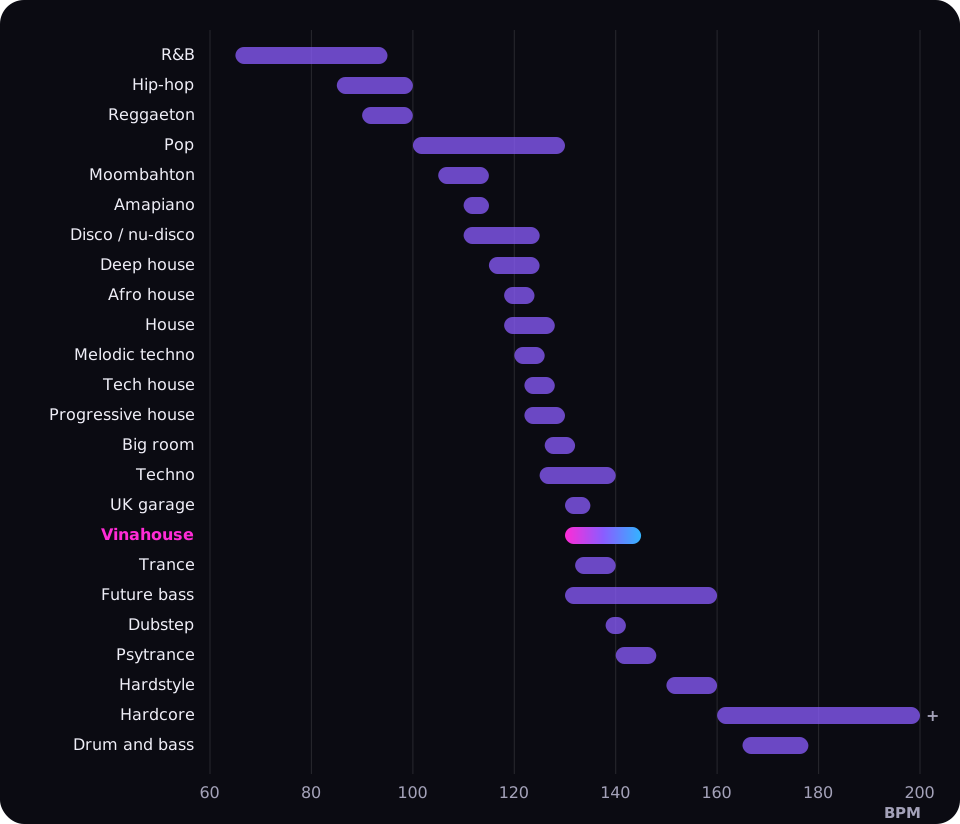
BPM by genre: the tempo chart
BPM, beats per minute, tells you how fast a track's pulse is. Every genre has a range where most of its tracks land. The chart below lists the usual range for each, from slowest to fastest. All numbers are approximate.
| Genre | Usual BPM | Notes |
|---|---|---|
| R&B | 65–95 | Slow jams can dip lower |
| Hip-hop | 85–100 | Some modern styles sit around 130–150, felt at half-time |
| Reggaeton | 90–100 | Around 95 is very common |
| Pop | 100–130 | Very wide; dance-pop is often 115–128 |
| Moombahton | 105–115 | Between reggaeton and house |
| Amapiano | 110–115 | Often around 112–113 |
| Disco and nu-disco | 110–125 | Live-feel grooves, often a little looser |
| Deep house | 115–125 | Warm, unhurried |
| Afro house | 118–124 | Percussion-heavy |
| House | 118–128 | Most club house sits around 122–128 |
| Melodic techno | 120–126 | Emotional, cinematic |
| Tech house | 122–128 | Often 124–126 |
| Progressive house | 122–130 | Long builds |
| Big room | 126–132 | Very often exactly 128 |
| UK garage | 130–135 | Skippy, swung drums |
| Techno | 125–140 | Harder styles go to 140–155 or more |
| Trance | 132–140 | Uplifting trance is often around 138 |
| Vinahouse | 130–145 | The deep style is slower, often under 125 |
| Psytrance | 140–148 | Rolling bassline |
| Dubstep | About 140 | Feels like 70 because of the half-time beat |
| Future bass | 130–160 | Usually felt at half-time |
| Hardstyle | 150–160 | Distorted kick |
| Drum and bass | 165–178 | Most often 172–175 |
| Hardcore | 160–200+ | Some offshoots go much faster |
If you want to know what each of these sounds like, not just how fast it goes, see EDM subgenres explained. For Vinahouse in detail, read what Vinahouse is.
Why genre tempos overlap
A genre is defined by its drums, bass, and sound, not by its tempo. That's why the ranges in the chart overlap so much:
- A track at 126 BPM could be tech house, progressive house, melodic techno, or techno.
- A track at 140 BPM could be dubstep, psytrance, hard techno, or a fast Vinahouse remix.
- Tempos also drift with fashion. A genre that sat at 124 a few years ago may sit at 128 today, or the other way around.
So BPM is a great filter for "can I mix these two tracks", and a poor answer to "what genre is this". Two tracks at the same BPM can belong in completely different folders.
Half-time and double-time in brief
Some tracks have two believable tempos. Dubstep at 140 BPM puts its snare on beat 3, so it feels like 70. Drum and bass at 174 often gets detected as 87. Hip-hop at 90 can be counted as 180.
Software has to choose one number, so it places every BPM inside a range, for example 78–155. Anything outside the range gets halved or doubled to fit. That's why a drum and bass track can show up as 87 in one program and 174 in another, and both are "right".
The fix is simple: pick a BPM range that matches the music you play, then the numbers line up. More on this in half-time and double-time BPM and how to find the BPM of a song.
How to use BPM to build a DJ set
Keep each transition within a few BPM
Most listeners don't notice a tempo change of about 3–4%, which is around 4–5 BPM at 128. Past about 6–8%, tracks start to sound rushed or sluggish. Without key lock, a 6% change also shifts the pitch by about a semitone, which can clash with the next track. Read how key lock works for the details.
Move the tempo in steps
A set feels like it's building when the tempo rises gradually. A simple house night might look like this:
| Set phase | Example tempo | Example style |
|---|---|---|
| Warm-up | 115–120 BPM | Deep house |
| Build | 120–124 BPM | House |
| Peak | 124–130 BPM | Tech house, techno |
| Closing | Hold, or ease back 2–4 BPM | Your strongest records |
Two or three BPM per track or two is plenty. Jumping from 118 to 130 in one transition usually sounds like a mistake rather than a lift.
Bridge genres through shared tempos
To move between genres without a hard stop:
- Walk through the overlap. Deep house to house to tech house to techno, a couple of BPM at a time.
- Use half-time and double-time. Hip-hop at 87 sits right on top of drum and bass at 174. Dubstep and psytrance both live around 140.
- Use a break or a cut for big jumps. When the gap is too wide, let a breakdown or a clean cut reset the room instead of forcing a long blend.
BPM first, then key
BPM tells you whether two tracks can be mixed. Key tells you whether they'll sound good together. Narrow your choices by tempo first, then check the key with the Camelot wheel. For a full walkthrough, see how to build a playlist by BPM and key and how to plan a set's energy flow.
FAQ
What BPM is house music?
House usually runs around 118–128 BPM, and most club house sits around 122–128. Deep house is slower, around 115–125, and tech house is often 124–126.
What BPM is techno?
Techno usually runs around 125–140 BPM. Peak-time techno often sits around 130–135, and harder styles go to 140–155 BPM or more.
What BPM is drum and bass?
Drum and bass usually runs around 165–178 BPM, most often 172–175. If software shows a drum and bass track at about 87, it's reading half the real tempo; widen the BPM range so it reads 174.
What BPM is Vinahouse?
Vinahouse usually runs around 130–145 BPM, faster than typical house. The deep style is much slower, often under 125 BPM.
What BPM is hip-hop?
Most hip-hop runs around 85–100 BPM. Some modern styles sit around 130–150 BPM but feel like half that, because the snare hits only once per bar.
Faster with Taxonomy DJ
Taxonomy DJ detects BPM, key, and Camelot for your whole library, over 100 tracks a minute, free and with no track limit:
- In the Music Library tab, click Add music folder, choose Analyze waveforms, then click Scan. Every track gets BPM, key, Camelot, and loudness.
- Click the BPM column header to sort by tempo, or use the filter above it to pick a range, such as 122–128 for a tech house set.
- Right-click a track ▸ Filter BPM ±3 to see what's within reach, or Filter harmonic matches to match by key.
- Play drum and bass or other music above about 155 BPM? In Settings ▸ Analysis, set BPM range to 88–175. The default is 78–155, and changing it updates every track's BPM right away, without analyzing again.
- In the Playlists tab, click New playlist, right-click tracks ▸ Add to playlist, and drag rows to order them by tempo.
To hear a track at your target tempo before you play it, click the speed pill (1.00×) on the player and choose By BPM: the tempo changes and the key stays put. Everything here works on the Free plan.
Read next: EDM subgenres explained and half-time and double-time BPM.