
Plan a shape, not a playlist
The most common mistake is planning a set as a fixed list of 15 tracks in order. The room never behaves the way you imagined at home, and a fixed list leaves you nowhere to go.
Plan the energy curve instead: where the set starts, where it peaks, and where it lands. Then build a pool of tracks for each part of that curve, usually around twice as many as you'll actually play. On the night you follow the shape and choose from the pool that fits the moment.
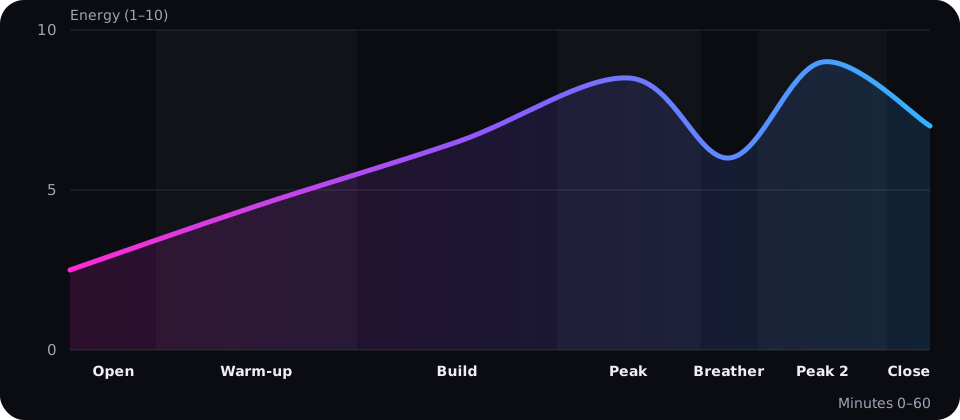
A good set rarely goes up in one straight line. It climbs in waves: a lift, a short release, a bigger lift. That contrast is what makes the peak feel like a peak.
The six parts of a DJ set
| Part | Its job | Energy (1–10) | What to play |
|---|---|---|---|
| Open | Set the mood, test the sound system | 2–4 | Groovy, roomy tracks with long intros |
| Warm-up | Get people moving without wearing them out | 4–6 | Steady grooves, few big drops |
| Build | Raise tension step by step | 6–8 | Fuller drums, more bass, rising vocals |
| Peak | The highest point of the night | 8–10 | Your strongest, most recognizable tracks |
| Breather | Give the floor a short rest | 5–7 | A melodic or vocal track, a lighter groove |
| Close | Leave a memory, or hand over cleanly | Depends | A signature track, or a level the next DJ can build on |
Not every slot has all six. A warm-up DJ might play only the open, warm-up, and the start of a build. A headliner walks into an already warm room and may skip straight to build and peak.
Warm-up vs peak time: play for your slot
Warm-up is a skill, not a lesser slot. The job is to make the room comfortable and moving, and to leave headroom for whoever comes next. That usually means a tempo a few BPM below what the night will reach, rolling grooves rather than huge drops, and saving the obvious anthems.
Peak time is where the big tracks belong. The room is full, people came to dance, and you can push tempo, intensity, and familiarity. Even then, a peak that never lets go turns into noise after 20 minutes. Keep the waves.
Closing depends on the night. The last DJ of the evening can bring the energy down gently and end on something memorable. If another DJ follows you, hand over at a level and tempo they can work with, not with your hardest track.
Three levers: BPM, key, and energy
- BPM. Raise it slowly: about 1 to 2 BPM per track, or a few BPM over 15 minutes, feels natural. Big jumps work better through a breakdown or a clean cut.
- Key. Moving through compatible keys keeps transitions smooth, and a planned key change can lift the room. On the Camelot wheel, two steps up (8A to 10A) is a classic lift for the build.
- Energy. This is the hard one, because no single number captures it. Energy comes from drum density, bass weight, brightness, vocals, and tension. Two tracks at 126 BPM in the same key can sit at completely opposite ends of a set.
BPM and key you can read off a screen. Energy you have to hear, which is why it's worth recording your judgment once per track instead of re-listening every time you plan a set. For the step-by-step mechanics of chaining tracks, see how to build a DJ playlist by BPM and key.
Group tracks by their role in the set
Instead of only sorting by genre, give every track a role: the part of the set where it works best. Many DJs keep crates like these:
- Opener: atmospheric, long intro, low pressure.
- Warm-up: steady groove, easy to mix, little drama.
- Build: more drive, rising tension, good for lifting the room.
- Peak: your heaviest hitters and biggest moments.
- Breather: melodic or vocal tracks that let the floor reset.
- Closer: tracks that feel like an ending.
Put each track where it fits best, even if it could work in two places. When you plan a set, you then take a few from each crate in order, and the energy curve almost builds itself.
The catch is the work: sorting a library of thousands of tracks by role, by ear, takes days, and every new download needs the same treatment. This is exactly the kind of sorting that software trained on your own crates can take over.
A 60-minute DJ set template
A sample hour for a house or techno set, opening at about 120 BPM. Played tracks average roughly 3 to 4 minutes, so an hour is around 16 to 17 tracks:
| Minutes | Part | Tracks | BPM | Energy | Key moves |
|---|---|---|---|---|---|
| 0–6 | Open | 2 | 120 | 3 | Same key or one step |
| 6–20 | Warm-up | 4 | 120–122 | 4–5 | One step at a time |
| 20–34 | Build | 4 | 122–124 | 6–7 | Steps, then one two-step lift |
| 34–44 | Peak | 3 | 125–126 | 8–9 | Same key or one step, keep it tight |
| 44–48 | Breather | 1 | 125 | 6 | Switch letter, minor to major |
| 48–57 | Second peak | 2 | 126 | 9 | One step or a lift |
| 57–60 | Close | 1 | 126 | 7 | Back toward the opening key |
Adjust the numbers to your genre and your slot. If you're warming up for someone else, stop after the build and hand over around energy 6. If it's your night, the second peak should feel bigger than the first.
Plan, then read the room
The plan is a map, not a script. Keep two or three alternatives ready for each part: a safer track if the floor thins out, a harder one if the room is ahead of you. Watch the dance floor, not the screen. And record your sets: listening back once tells you more about your energy curve than any amount of planning.
FAQ
How many tracks do I need for a 1-hour DJ set?
Usually around 12 to 20, depending on the genre and how long you blend. Prepare about twice that many, grouped by role, so you can react to the room instead of following a fixed list.
Should I plan my set track by track?
Plan the shape and a few anchor tracks, like your opener and your peak moments. Fill the rest from pools of tracks for each phase. A fully scripted set breaks the moment the crowd does something unexpected.
What BPM should a warm-up set be?
It depends on the genre and the night, but a warm-up usually sits a few BPM below the peak. For house, that often means starting around 118 to 122 and leaving the higher tempos for later. Follow the DJ before you, and leave room for the one after.
How do I know a track's energy level?
Listen and decide where it fits in a set, then record that decision once, as a crate, a label, or a note in the comment tag. Software can learn those decisions and suggest a role for new tracks, but your ears set the standard.
Faster with Taxonomy DJ
Automatic music classification in Taxonomy DJ can label new music by set role, using your own crates as the lesson:
- Make one folder per role (Warm-up, Build, Peak, Closer…) with your most typical tracks, ideally about 100 each. In the Training tab, click Add label for each folder, or From parent folder to add them all at once.
- In the Music Library tab, click Add music folder, choose Run full analysis, and click Scan. Every new track gets a role label with a % Confidence, plus BPM, key, and Camelot. Click Quick filter ▸ Needs review to check the unsure ones, and fix labels with the 1–9 keys.
- Planning a set? Use the filter above the column headers to show only Peak tracks in a BPM range, then right-click a track ▸ Filter harmonic matches or Filter BPM ±3 to find what follows it. Right-click ▸ Add to playlist, reorder in the Playlists tab, and Export M3U file for your DJ software.
Training and automatic labels need Premium. BPM, key, Camelot, and playlists are free on every plan.
Read next: how to build a DJ playlist by BPM and key and what the Camelot wheel is.